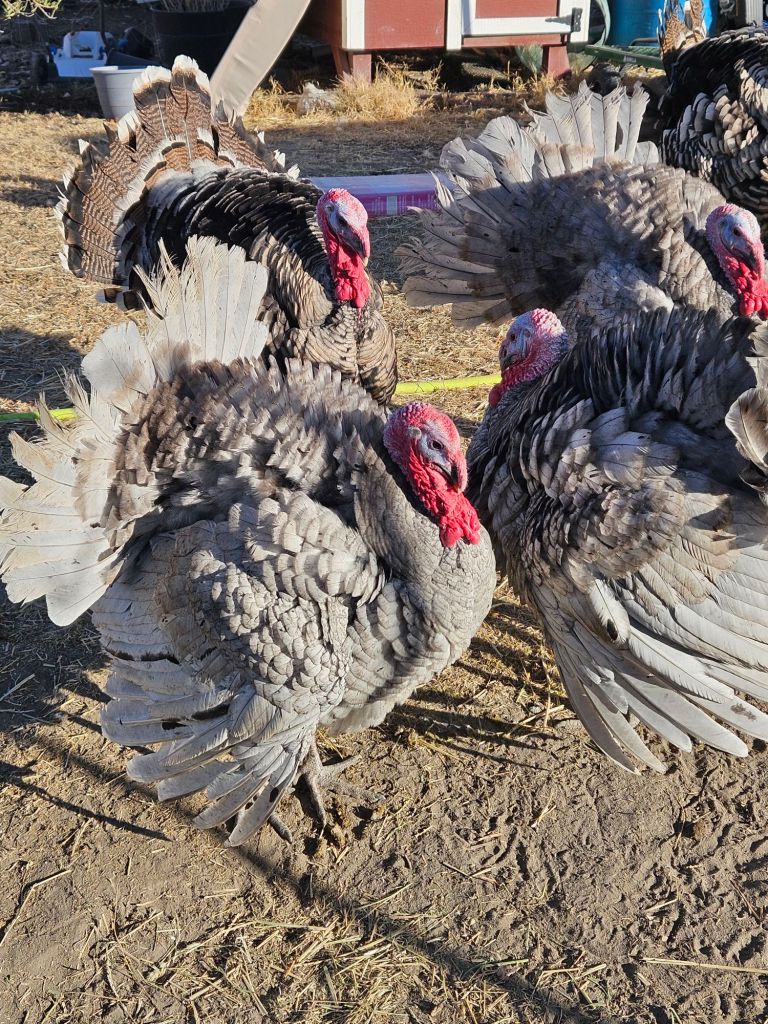
Today, I was cleaning out the turkeys. One of our hens likes to sit on the top and look down on me as I clean them out. Today, she decided for the first time that my ponytail looked like it would be fun to grab.
She did this about 2 times, but the 3rd time she was successful in ripping out my hair tie jumping off the roof. I chased after her around their run area I did in deed get the hair tie back.
My advice would be to watch your hair accessories and that turkeys can in deed run fast when they want to.
We had a little bit of snow today. Mostly rain, though. I took this time since everything is muddy to do some planting!
Chocolate cherry sunflowers
Mongolia giant sunflower
Emily basil
Cinderella pumpkin
Mint mountain
Spinach
Pepper ashe County pimento
Sweet corn
Lemon balm
Corn hopi pink
Brown sugar tomato
Tatsoi
I get my seeds from bakerscreek. The brown sugar tomato would be the one I’m most excited about. The other one I would be excited to try is the pepper ashe County pimento. I’m looking forward to trying to making pickled eggs with them.
Today, my daughter pulled one of the beets to give to the livestock, and it was the biggest one we have grown yet.
Tomorrow, the livestock will be very happy to get this big one.
Doris is my Red Shoulder Yokohama hen. I’ve been wondering when she would start to lay.
My friend and I thought it would be around May, but I had a wonderful surprise today when I went out to check on things.
Doris laid her first egg!
1639 to 1854 – almost all of the Edo period – Japan was effectively closed to foreign trade. Under the Convention of Kanagawa of 1854, there were five ports that were to be constructed for trade with the rest of the world. One of these was Yokohama!
Seven among the goods exported to Europe were traditional Japanese long-tailed chickens; the first documented export was in 1864. In that year, some of the birds reached the Jardin Zoologique d’Acclimatation in Paris, where they were named Yokohama for their port of origin.
We are to have another storm where I live. They are saying 3 to 6 inches of snow. I could care less about the snow. Every homesteader knows about getting work done in the snow. For me, it’s the wind storms. I can’t get work done in wind storms.
Everyone is always asking how to keep their runs for their girls/ guys ( chickens hens / roosters) to not move/flip during a wind storm. I love the idea of using cinder blocks on the outside of the runs. Planting herbs in the cinder blocks. I have this project for my homestead for during the spring or summer. Until then, though, I use Eurmax USA U-Shaped-Rebar-Stakes-12-Inch, Ground Stakes Heavy Duty.
I put two on each side of my longer runs and one on each side of my shorter runs.
The girls/ guys didn’t care about me adding the stakes. The turkeys did, and they tried to help.
While most wait until after the frost date to start planting, there are a huge amount of us who plant now!
I was excited to see my Pink Dandelion starting to srpout!
This is my first year growing these ones. I can’t wait to make jam, tea, and, of course, getting seeds to plant more of them. 7 to 21 days for germination. 60 to 95 days until it blooms. I have started mine in the greenhouse, and I will be planting them in the outdoor garden area. I just haven’t decided where yet.
This blog post isn’t just about planting. I do have to show off my Dark Brahma cockerel.
I love the Dark Brahmas, but I would love to get some Isabella Brahmas. Show me your chickens!
I’ve loved the breed Russian Orloff for a long time.
When we lived in the city, I received two chicks not knowing anything about the breed.
The Russian Orloff was considered to be a product of Russia and Orlov. Modern research has discovered that the breed first appeared in Persia and was distributed across Europe also Asia by the 17th century.
In 1884 that the first Orloff chickens were imported to Central Europe from the Russian Empire. The breed then reached the Saxon professor Friedrich Zürn (1835-1900) in Leipzig. The breed then came to possession of Baron Ludwig von Villa-Secca Navarro d’Andrade (1822-1894) to Vienna-Ottakring.
Orloffs were first introduced to Great Britain in the 1920s. Germans created the first miniaturized bantam Orloff by 1925. The breed was once included in the American Poultry Association’s breed standard, the Standard of Perfection, but it was removed due to a lack of interest from breeders. In the 21st century, Russian Orloff remains a rare breed in the West. The Livestock Conservancy lists the breed as critically endangered.